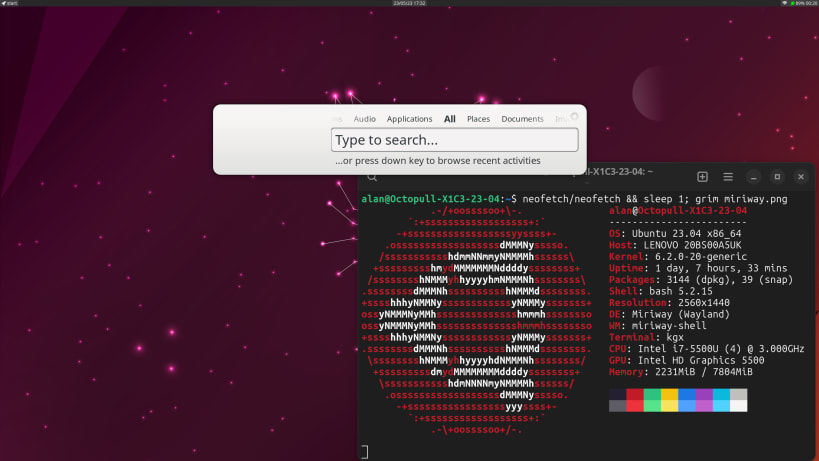

Miriway is a generic Wayland compositor implementing a traditional floating window management policy. It handles native Wayland extensions, supports legacy X11 applications via Xwayland, and leverages the robust Mir display server library to bring dynamic workspaces, hybrid graphics, and remote desktop support to your environment.
Getting Started
Miriway is highly configurable. When you run this snap, it looks for configuration components in ~/.config.
To get you up and running instantly, Miriway ships with example setup scripts for popular lightweight desktop environments. These create the configuration files needed in ~/.config and, optionally, install the components of these desktop environments:
ls  /snap/miriway/current/example-configs/
Budgie.bash  LXQt.bash  MATE.bash  SWAY.bash  XFCE.bash  alan_g.bash
You can easily test them and/or use them as a blueprint for your own custom setup. Note that these are provided on a "best effort" basis as they rely on the corresponding components on the host OS and we cannot test everything everywhere.
Detailed setup instructions, example scripts, and configuration guides are available in our documentation: https://github.com/Miriway/Miriway/
Perfect for Desktop Migrations
Miriway acts as a production-ready, off-the-shelf compositor designed to help modular, resource-light desktop environments (like Budgie, LXQt, and Xfce) transition away from X11 without having to develop a compositor from scratch. To provide a starting point here are some setup scripts:
Miriway is based on Mir: https://mir-server.io/
You are about to open
Do you wish to proceed?
Thank you for your report. Information you provided will help us investigate further.
There was an error while sending your report. Please try again later.
Snaps are applications packaged with all their dependencies to run on all popular Linux distributions from a single build. They update automatically and roll back gracefully.
Snaps are discoverable and installable from the Snap Store, an app store with an audience of millions.
Snap can be installed from the command line on openSUSE Leap 15.x and Tumbleweed.
You need first add the snappy repository from the terminal. Choose the appropriate command depending on your installed openSUSE flavor.
Tumbleweed:
sudo zypper addrepo --refresh https://download.opensuse.org/repositories/system:/snappy/openSUSE_Tumbleweed snappy
Leap 15.x:
sudo zypper addrepo --refresh https://download.opensuse.org/repositories/system:/snappy/openSUSE_Leap_15.6 snappy
If needed, Swap out openSUSE_Leap_15. for, openSUSE_Leap_16.0 if you’re using a different version of openSUSE.
With the repository added, import its GPG key:
sudo zypper --gpg-auto-import-keys refresh
Finally, upgrade the package cache to include the new snappy repository:
sudo zypper dup --from snappy
Snap can now be installed with the following:
sudo zypper install snapd
You then need to either reboot, logout/login or source /etc/profile to have /snap/bin added to PATH.
Additionally, enable and start both the snapd and the snapd.apparmor services with the following commands:
sudo systemctl enable --now snapd
sudo systemctl enable --now snapd.apparmor
To install miriway, simply use the following command:
sudo snap install miriway --classic
Browse and find snaps from the convenience of your desktop using the snap store snap.

Interested to find out more about snaps? Want to publish your own application? Visit snapcraft.io now.